


4 WEEKLY SESSIONS
February/March 2026
** Register 1 week in advance to avoid cancellation due to lack of enrollment**
4 Mondays
Feb 9 - March 2
Wax Working for Casting
6:00 - 9:00
(William Greenwood)


Please try again in the March/April session
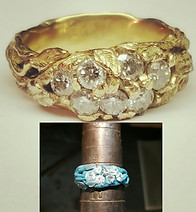
The casting process is primarily used for two reasons: Wax is the best means for producing the design and/or production of multiple pieces that are identical and can be cast in brass, bronze, silver, gold of any karat and color or platinum. It’s economical because it yields minimal scrap and is the preferred method of creating wedding bands because it signifies a seamless never-ending circle. Understand the casting process from soup to nuts! Students will learn how to carve wax models for casting in the metal of their choice (the actual casting will be done by William).
Skill Level: No experience necessary (but it’s helpful)
Tuition: 250.
Lab Fee: 15.
Materials: 25. (additional fee for casting)
4 Tuesdays
Feb 10 - March 3
Rings Galore!
2:00 - 5:00
(Raychel Wengenroth)


Rings are a rewarding way to learn a wide variety of techniques including forming, soldering and forging (oh, and that geometry class will finally come in handy!) The endless variety of ring types and the incredible array of technical approaches to them will create a rich learning experience. Students are encouraged to work on different projects to accommodate their skill level while interacting with their peers for experiential learning. Stackable rings are perfect for beginners, spinners and hollow rings are great for more advanced students. More advanced students can also incorporate previously explored surface treatments such as stamping, hammering, roller-printing and marriage of metals like copper, brass and bronze. Rings can be plain metal or featuring set stones.
Skill Level:Basic 101
Tuition: 250.
Lab Fee: 15.
Materials: Sold by weight (at market price) in class or students can purchase their own.
Basic 2 - Soldering & Bezel Setting
6:00 - 9:00
(Raychel Wengenroth)


It's time to learn various hard silver soldering techniques including butt joints, sweat and point soldering. During this session you will come to understand the different melting temperatures of solder and when to use them, the purpose of flux, pickle, heat sinks and depletion gilding.
Stone setting introduces students to the basics of bezel setting cabochon stones. This is a great combination of skills to expand your technical toolbox and it is where the fun really begins!
Projects may include (but are not limited to): Adding a stone to your silver ring, pendants, earrings, etc.
Skill Level: Basic 101
Tuition: 250.
Lab Fee: 15.
Materials: 50.
4 Wednesdays
Feb 11 - March 4

Wrap It Up!
2:00 - 5:00
(Armando Blanco)


In this wire wrapping course, we will be going over all the techniques that will get you started on your path towards wire art. Not only will we cover the basics, but we will go over bale decorations, how to turn your cabochon into a ring, how to coil, and how to weave. I will be an open book. My goal is that by the end of this course, you will be able to develop your own style of wire wrapping.
Students need to purchase their own set of nylon pliers which are essential for homework. Details for ordering, as well as the weekly lesson plan, will be emailed to registered students.
Skill Level: Absolutely No Experience Necessary
Tuition: 250.
Lab Fee: 15.
Materials: 40.
Forming & Fabrication
6:00 - 9:00
(Raychel Wengenroth)


Forming is the process of bending metal (sheet or wire) to achieve a dimensional aspect. Whether bending a ring blank to make the perfect solder seam, scoring a 90 degree angle for a box or dapping a bowl for functional objects, the vast array of uses for this technique are virtually endless. Learn about the different mallets and stakes used for shaping metal without distortion. Dapping as well as swage block materials & use, plus basic anticlastic raising techniques will be demonstrated.
Skill Level: Basic 101, 2 and 3 (or the equivalent)
Tuition: 250.
Lab Fee: 15.
Materials: 30.
4 Thursdays
Feb 12 - March 5
Independent Study
12:00 - 3:00
(Raychel Wengenroth)


For students with a broad range of technical skills needing individual attention with more advanced projects, from planning and materials needed to step by step process planning and hand holding. This class is a flexible continuation of your skills enabling you to have one on one consultation with the instructor. New techniques will be explored as individual needs are addressed. Classmates can observe demonstrations as they see fit.
Skill Level: Basic 101, 2 and 3 (or the equivalent)
Tuition: 250.
Lab Fee: 15.
Materials: Students bring their own